Monday, 18 October 2010

Birmingham Dive Show and November DIVE Magazine!


Acuatours, our travel company will be hosting stand number 230 at the forthcoming Birmingham Dive Show (October 30th and 31st). We are also featured in a full page article by Tim Ecott in the November issue of Dive Magazine. Come and see us on the stand and chat to us about our work this year, and we will see if we can fit you on a space during 2011. We will even let you buy us a cup of coffee...or even a beer if you are really lucky...

Saturday, 16 October 2010

Ecuador: Grace Under Pressure


Here are a couple of images I took in my last few days of my recent time in Puerto Lopez. Ecuador has always been a turbulent country, and recently the propensity of its people to generate their own instability showed itself again, with futher unrest in the capital, said to be part of the aftermath of the events that unfolded in Quito on September the 30th.
So unrest is nothing new. What is new to the people of Ecuador is stability and direction, and the pressure that that brings. Maybe things are beginning to crack, but then again, maybe it is just society adjusting itself to the effects of long term growth, change and a new found national responsibility. In these difficult financial times, felt by countries rich and poor, there can be no certainty of the outcome.
Ecuador is a gem in the world's crown, and like that of any country, its future can be seen only through the eyes of its children.

Sunday, 3 October 2010

The Secret Garden

We are drawing our research here in Ecuador to a close for the season. The mantas have not been seen here for over ten days now, and it looks like they have moved away on their migration to who knows where, and won't be back until well into next year, when we will be back again to meet them.
This week though, it wasn't a manta ray that took our breath away and had us talking long into the night about our latest discovery. This is one of the privelages that one is presented with as a researcher; that of exploration. We had heard mention of one or two deepwater pinnacles, where the fishermen talk about sharks and other ocean going creatures, but we have never had the privelage to have visited them. However, our building of trust that has been going on over the last years, today bore fruit, and we were taken to one of the mystery sites to dive, probably for the first time ever. Too deep for hookah fishermen, and never dived by sport divers, we were to be the first people ever to set eyes on this site.

It wasn't a deepwater monster that greeted us however, infact it was quite the opposite. Our nearly 40 metre deep dive took us to some of the most beautiful coral gardens we have ever seen. Huge rock formations punched wierd cavernous shapes up into the stark azure backdrop, caverns, walls and tables lay before us. It seemed to me that we were witnessing the aftermath of a game of dominoes, or jenga, played by giants from eons past, such was the chaotic order of the rock about us. But covering those dark and forgotten boulders was a marvel of coral and sponges probably not seen between here and the red sea or the carribean. I hope these few images do it justice. I was really surprised at how pristine the site was, considering that it is a commonly visited fishing spot, but then the huge rocks would keep any sane net worker a good distance out.

We will be back there, to see if we can find out more about that secret garden, and hopefully uncover a few more of its hidden gems.

Sunday, 26 September 2010

The Real Deal


There has been an unfortunate amount of banter going on in the shark diving community over the past few weeks, and recently has come to something of a nasty climax. I am in two minds at this point whether or not to comment, but I think that one overbearing issue should not be ignored, nor forgotten. That issue, conservation, is the one that drives us all, and probably why we are all here in the first place.
The more infighting and back stabbing that goes on, the weaker we become as a group. Marine conservationists are a wierd bunch of poeple, we all ask for as much help as possible to achieve our aim from a joint perspective, but when it comes to working together for that sole aim; ideals, objectives, and cashflow get in the way, and before we know it, barriers go up and we become a collective of individuals, rather than a unified movement. This, I guess, given the nature of the beast, is inevitable. We all paint our garden fence nice and pretty, to attract the vital incomes that keep us all going, but that same pretty fence is a barrier to powerful alliances and friendships that could help us achieve our prime objective: to conserve the ocean realm.
I can count on one hand the individuals who I know that fully understand the significance of this, and one or two of them I know are involved in the recent debacle. I am surprised, and saddened by the tone of recent public communication over the issue, and I hope that all parties involved will consider the image I posted above, and make the right decisions over the coming months to unify a quickly dissolving alliance of like minds, for the benefit of all of us.
The SA press today released a story about a poacher being killed in Gansbaai, and typically of the media, the overriding tone of the article was not how we might control poachers, but whether the shark feeding industry in the area was to blame for the poachers death. It is this I guess that prompted me to write this blog. We have enough people in our world trying to shut doors on our good work. We should not be shooting each other in the foot. For the sake of sharks all over the world, the prime movers in the industry must reunify, and form a transparent, faultless standard for feeding practice that is beyond reproach.

Wednesday, 22 September 2010

The Manta Dance

We've been suffering a bit with seemingly grumpy mantas who's mode of behaviour over the last few days has been restricted to 'fly by'. With this in mind we decided to resurrect the manta dance, which has been modernised and up-tempoed by our recent manta buddy Larry Chow (video to follow). Anyway, whatever vibe Larry was wacking out, it worked and this mantazo stayed around to show is his own verion of the manta mamba. Good Work Chowster!!


Sunday, 19 September 2010

Mantas Behaving Badly


Oh dear! I couldn't think of a better title, which just goes to show how much I watch TV these days. I had the pleasure of meeting Martin Clunes last week, when he came to interview me as part of his next natural world documentary called Man To Manta. He was part of a team that arrived to shoot my work here as well as feature my best manta buddy Andrea Marshall, who was with us to satellite tag some of our rays as part of her worldwide study on Manta birostris.
True to any animal that gets to go on TV, the mantas refused to turn up for the cameras and in a show of defiance, left our study area for about five days. To be honest I was pretty happy with that as it adds to the mysterious awe they eminate when we do get to see them, and I hope the guys get to do that justice when they get in the editing suit. Man to Manta is due to air on the 2nd of January on ITV.
As for our mantas, they turned up again a couple of days ago and I will blog again soon with and update on how we are doing.
A pretty terrible photo of me, but a decent one of the other two..! Credit: unknown.

Saturday, 4 September 2010

One Manta In Time

There are certain events that happen in our lives that mark them for all of our limited sense of eternity, thoughts and memories that stay with us for the rest of our lives. Our short time on this planet is punctuated by events, so called rites of passage, birth, adolescence, falling in love, marriage, death. They effect us in such meaningful ways, but they affect only us personally and the handful of the people we surround ourselves with.

It is not often that we get to be involved in a moment in history that will be remembered for the rest of human time; recorded in Natural History Museum displays and vaults for the benefit of all of our descendants to come. Today I was involved in such an event, and as much as an encounter with a manta ray is always profoundly special to me, our encounter with this particular one will stay with me, and will be sigificant for the rest of the manta birsotris species for time eternal.

Five years ago I encountered my first manta ray at Isla de la Plata, and since then I have done what little I can to bring some sense of importance to the species in this area, and hopefully repay those magnificent rays with whatever I could to do help them enjoy a long and sustainable existence in the Pacific Ocean that they call home.

My interest in them soon had me taking handfuls of identification shots but it wasn't until 2009 when I brought my first volunteer researchers to Ecuador that the significance of this population became apparent. Unbeknown to me I had opened a chapter in someone elses life all the way over in Mozambique; Dr. Andrea Marshall soon got to hear about this population through my work, not too long a grapevine considering the tiny world of manta research.

With the support of the Save our Seas foundation, Andrea had embarked on a global manta ray satellite tagging program, and I myself had been awarded a Save Our Seas grant to continue my research here. By late 2009 it was almost inevitable that we were looking at making the first ever satellite tagging event in the eastern Pacific Ocean.


My work however was only based on four or five months work spread over five years, and given the fickle nature of the natural world, let alone the unpredictability and small population sizes of Manta birostris in pretty much all the places they are found, even up until the last minute, the whole project seemed it could easily fall into the catoegory of "An Impossible Gamble". Close to Andrea's visit date though, manta numbers seemed good, and despite challenging visibility and strong currents, we were getting regular sightings.
Our first dive was, for me, disappointing, a low amount of mantas seemed in a fickle mood and were navigating nonchallantly past us, cephalic fins tightly rolled, and it wasn't until later in the dive when we had all run out of air, that a relaxed, circling manta was spotted.
On our second dive to the same location, we were quickly into a more relaxed number of rays, but the visiblity looked somewhat reduced compared to the previous dive. I watched Andrea ready herself above one moderately sized male, and in a flurry of hand signals and fin strokes the manta decided he would dissapear into the enclosing gloom. Not two seconds later then another unmistakable shape appeared. It all seemed good. We were on a rock wall sitting above 100 metres of dark Pacific Ocean. The heavy plankton bloom fell around us like snow. Our limited range of viz made it feel like we were inside some kind of winter bound amphitheatre. All other divers had melted away into the darkness and it was just me, the queen of mantas, and...a manta. Heaven.

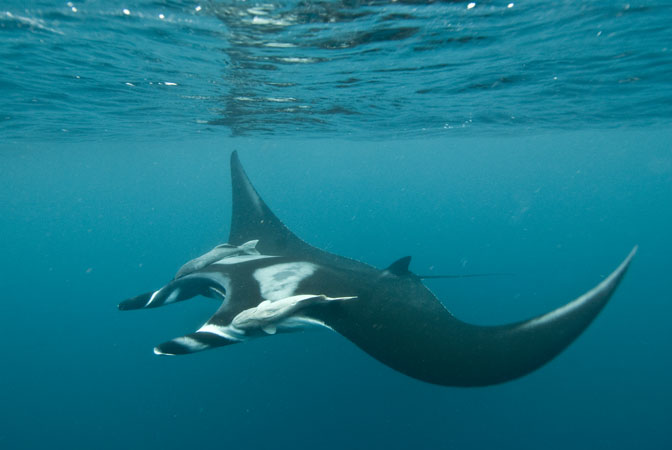
After diving with many very inspiring watermen (and women!) over my short underwater career, it takes a pretty special kind of diver to impress me, but the way Andrea handles all her tagging and camera and sampling equipment underwater is, well, impressive. With the blink of an eye the tag was in, and Andrea had changed tactics, now looking to photograph the tag to see if it had set properly. The manta received the tag with a movement that can only be described as just having had her bum slapped. Other than that she just resumed her nonchalant swim over the wall area, and dissapeared a fast as she had arrived.


Andrea dissapeared with her and for that moment I thought it was all over. I hung on the top of the wall in the current, breathing heavily after all the effort, looking down into the black deep listening to the strained wheeze of my regulator. I looked up to make my way back to the pinnacle to safety stop my way out of the site and nearly bumped my head on a large speckled belly sitting only ten centimetres above my head. At first I wasn't surprised as it wasn't unusual to see mantas do that here, they love hanging in the current with an annoyingly relaxed look on their face whilst us stupid and inefficient humans battle in our little plastic fins. As she gently slid back to come for another look at me, she dipped below the wall and I couldn't quite believe what I was seeing. There she was, the first ever manta to be tagged in the South American Pacific, hanging in front of me, studying me with her wide set, trusting and beautiful eyes. What she was doing there, why she came back to me, why she stayed with me for those eternal minutes effortlessly floating in the whistling current I will never know. I can only guess, hope, that she understood all the intense effort that is going on above her wide ocean waves to save her and the rest of her kind from what us humans know is happening to them.

Today was a special day, not only for me, but for mantas and manta lovers everywhere. I want here to publicly and warmly thank Andrea Marshall for her sincere effort directed towards a greater understanding of these magnificent ocean giants, and I would like to also thank her on a more personal level for affording me the undeniable privelage of being present when the first tag here went on.

This tagging program will enable us to learn a little more about this population and will give me a valuable insight to their lifestyle. I can then use that information to develop more indepth studies to gain further knowledge that will be valuable in our wider understanding of the species, both on a local and international level.